Sunday Soul Food Dinner: A Full Menu and How to Plan It
As an Amazon Associate I earn from qualifying purchases and sometimes recommend products from other sellers at no extra cost you. For more details see my disclosure policy and privacy policy.
A proper Sunday soul food dinner is built around one protein, two or three sides, a bread, and something sweet to finish, all timed so they land on the table together rather than in stages. This guide sets out a complete, tested menu using five recipes from this site, plus the cooking order that gets everything hot at once, and the UK conversions you need if collard greens and buttermilk aren’t sitting in your local supermarket.
I’m not from the American South, and I’m not going to pretend otherwise. I’m a home cook in Telford who got curious about soul food, started testing it properly, and kept notes on what actually works when you’re cooking it from a British kitchen. This is one of those notes, scaled up to a full Sunday spread.
🍗 What Makes a Sunday Soul Food Spread a Tradition
Sunday dinner in soul food cooking is less about a single dish and more about the whole table. Historically, it’s the one meal of the week where time and effort go into cooking low and slow, several dishes get made at once, and everyone eats together. That’s the bit worth understanding before you plan a menu: it’s not one recipe, it’s a spread, and the spread is the point.
I’m not going to turn this into a full history lesson. What matters for planning purposes is that a Sunday soul food dinner is expected to have range: something rich and slow-cooked, something green, something starchy and comforting, bread, and pudding. Once you know the shape, building your own version gets a lot easier.
🍽️ How to Build a Balanced Soul Food Plate
The formula that works every time is one protein, two to three sides, a bread, and a dessert. That’s it. You don’t need six side dishes to do this properly, and trying to cook that many at once is how Sunday dinner turns into a stressful afternoon instead of a relaxed one.
A few combinations that hit the right balance:
- Ribs, collard greens, mac and cheese, cornbread, and a simple dessert
- Ribs, collard greens, coleslaw, cornbread, and a simple dessert
- Ribs, coleslaw, mac and cheese, cornbread, and a simple dessert
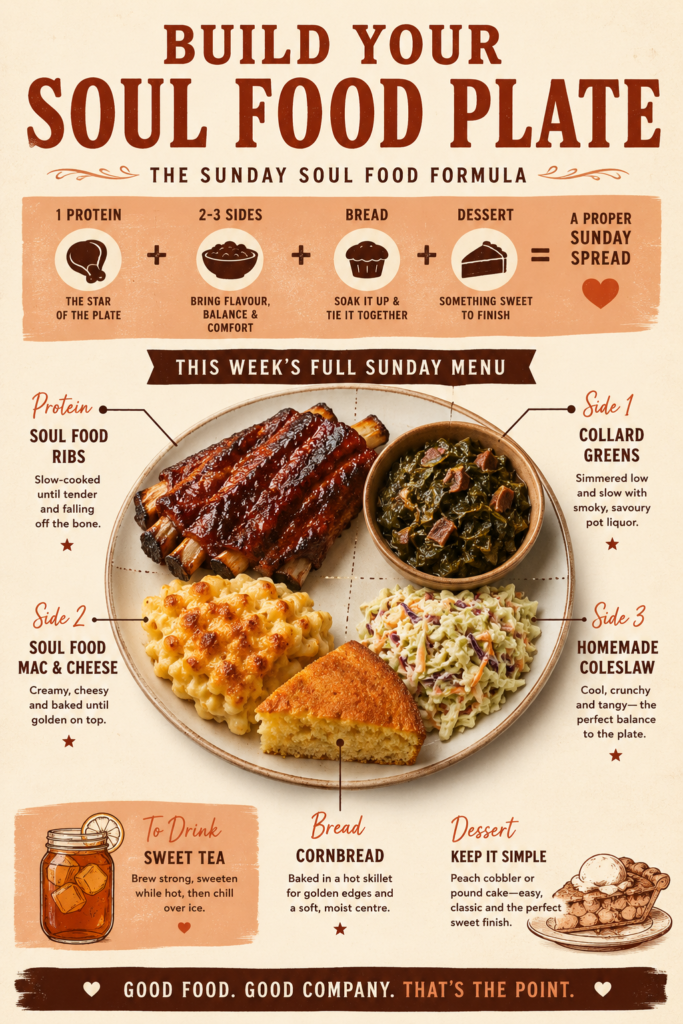
Notice the pattern: one rich, slow-cooked protein anchors the plate, one green or vinegar-forward side cuts through the richness, one creamy or starchy side adds comfort, and cornbread ties it together. Dessert is separate and can be as simple as you like.
📋 The Full Menu: A Ready-Made Sunday Soul Food Spread
If you want a menu that’s already worked out for you, here’s the one I’d put on the table, built entirely from recipes on this site so you’re not hunting around for five different sources.
- Protein: Soul Food Ribs, slow-cooked until the meat pulls away from the bone with almost no effort.
- Side one: Collard Greens, simmered low and slow with a smoky, savoury pot liquor.
- Side two: Homemade Coleslaw, which brings the acidity and crunch the rest of the plate needs.
- Side three: Soul Food Mac and Cheese, baked until the top is properly set and a little crisp at the edges.
- Bread: Cornbread, made in a hot skillet so the edges catch a bit of colour.
- Dessert: keep it simple. A peach cobbler or a basic pound cake both work without adding another slow-cooked element to your afternoon.
You don’t have to make all three sides. If you’re cooking for a smaller group, drop the mac and cheese or the coleslaw and the plate still holds together. What you shouldn’t drop is the cornbread. It’s doing more work than it looks like on paper, soaking up pot liquor and pulling the whole plate together.
On dessert, resist the urge to overthink it. A peach cobbler needs about an hour in the oven and can go in alongside the mac and cheese if your oven has the space, or it can be made the day before and warmed through gently. A pound cake is even simpler, since it’s just as good cold and can be baked days ahead and kept in an airtight tin. Neither dish needs babysitting on the day, which matters when you’re already juggling ribs, greens, mac and cheese, and cornbread.
To drink, sweet tea is the traditional pairing, and it’s easy enough to make UK-friendly. Brew a strong pot of black tea, stir in sugar while it’s still hot so it dissolves properly, then chill it over ice. If sweet tea isn’t your thing, a jug of lemonade or even just chilled water with lemon slices does the job without competing with the richness of the food.
⏰ The Cooking Timeline: What to Start First, What to Finish Last
Timing is the part that actually determines whether Sunday dinner feels calm or chaotic, so here’s the order that works.
Morning, first thing: Get the ribs going. They need the longest cook time by far, whether you’re doing them low and slow in the oven or finishing on a smoker, so this is the anchor everything else is scheduled around. Once they’re in, they mostly look after themselves.
Late morning: Start the collard greens. They also want a long, slow simmer to properly soften and pick up flavour from the smoked meat or seasoning in the pot, so get them on not long after the ribs go in. Check and stir occasionally, but they don’t need constant attention.
Early afternoon, one to two hours before eating: Make the coleslaw. This is a fridge job, not a stove job, and it actually benefits from sitting for a bit so the dressing has time to soften the cabbage. Get it done and out of the way while the ribs and greens are still doing their thing.
About an hour before eating: Assemble and bake the mac and cheese. It needs oven time to set properly and get that top layer of texture, so this is when the oven becomes a shared resource between the mac and cheese and, later, the cornbread.
Thirty to forty minutes before eating: Make the cornbread. It bakes fast in a hot skillet, which is exactly why it goes last. There’s nothing worse than cornbread that’s gone dry sitting around waiting for everything else to catch up.
While the cornbread bakes: Pull the ribs, check the greens are done, and start plating. This is also your window to warm serving dishes if you’re using them, so the food doesn’t cool the second it hits the table.
The short version: ribs and greens start the day, coleslaw happens mid-afternoon in the fridge rather than on the hob, and mac and cheese and cornbread are the last two things into a hot oven so nothing sits around going cold or dry.
UK Kitchen Notes: Temperatures, Conversions and Substitutes
A lot of soul food recipes are written with American ovens, cup measurements, and ingredients that aren’t always sitting on a UK supermarket shelf. Here’s what to know before you start.
Oven temperatures. American recipes are usually in Fahrenheit. As a rough guide: 325°F is 163°C, 350°F is 180°C, and 375°F is 190°C. If you’re using a fan oven, knock about 20°C off whatever the recipe states for a conventional oven.
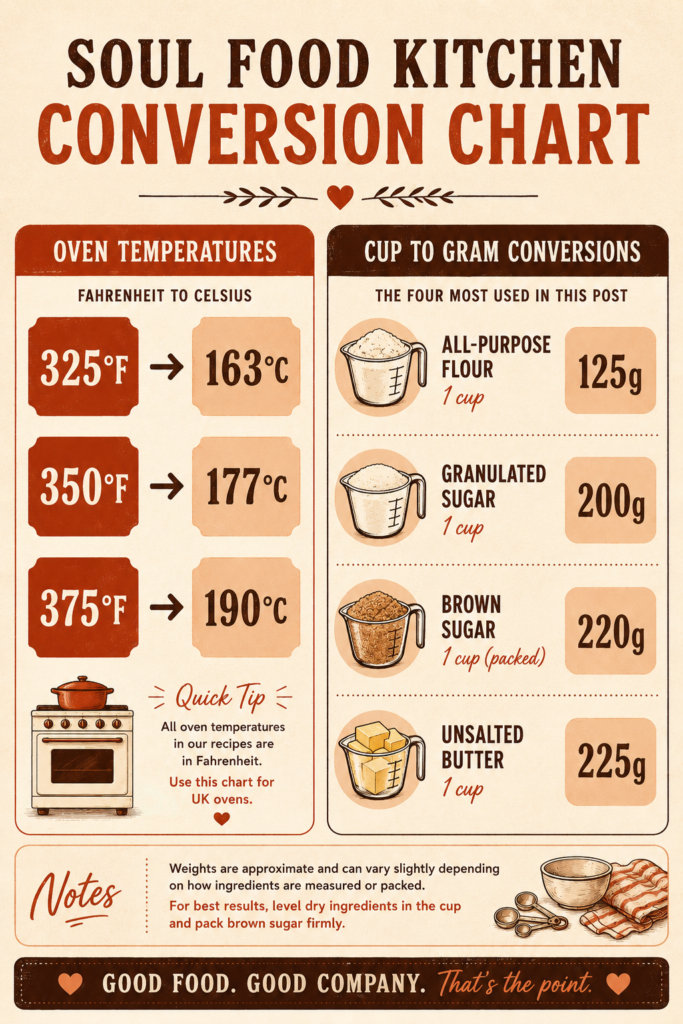
Cup to gram conversions. A cup of plain flour is roughly 125g, a cup of granulated sugar is roughly 200g, a cup of butter is roughly 225g (two standard UK blocks would be closer to 250g, so weigh rather than eyeball it), and a cup of milk or buttermilk is roughly 240ml. Digital kitchen scales make this whole exercise far less stressful than trying to find the right cup measure.
Collard greens substitute. Proper collard greens can be hard to track down outside specialist shops. Spring greens are the closest UK substitute in texture and flavour, and curly kale works too, though it needs slightly less cooking time as it breaks down faster.
Buttermilk substitute. If your local shop doesn’t stock buttermilk, stir a tablespoon of lemon juice or white vinegar into a cup of whole milk and let it sit for ten minutes until it thickens slightly. Natural yoghurt thinned with a splash of milk is a reasonable stand-in too.
Smoked meat and seasoning. Where a recipe calls for a smoked ham hock or similar, a good UK butcher can usually point you towards a smoked bacon joint or smoked pork hock as a substitute, which does a similar job in a pot of greens.
None of this changes the character of the dish. It just means you’re not stuck if your shop doesn’t carry the exact ingredient an American recipe assumes you have.
🥘 Make-Ahead, Reheating and Scaling the Menu Up or Down
What to make ahead. Coleslaw actually improves overnight in the fridge, so it’s the easiest thing to get done a day early. Collard greens reheat well too and often taste better the next day once the flavours have had time to settle, so cooking them the day before and warming them through on Sunday is a solid move if your schedule is tight.
What not to make ahead. Cornbread is best fresh out of the oven. It will keep, but the texture drops off fast, so this is the one dish worth timing to finish right before you serve.
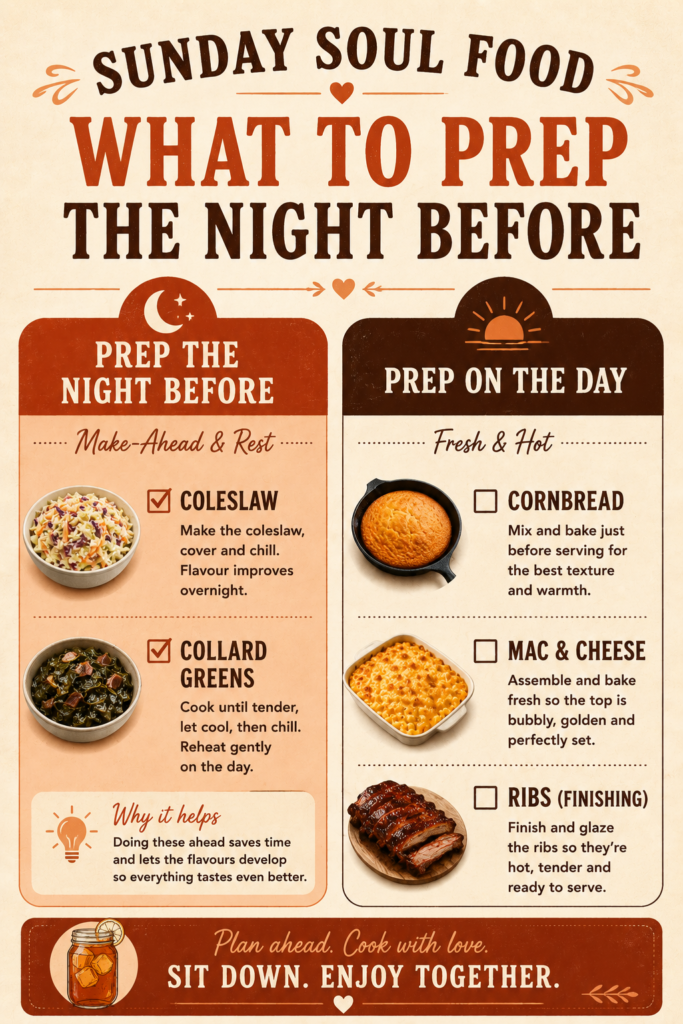
Reheating the ribs. Wrap them in foil with a splash of stock or water and warm them low in the oven rather than blasting them in a microwave, which dries them out. Slow and covered keeps them tender.
Scaling down. For two to four people, halve the ribs and greens, keep the coleslaw and cornbread roughly as written since both keep well, and skip the mac and cheese if you want to keep things simple.
Scaling up. For a bigger table, the ribs and greens scale easily since they’re both cooked in bulk anyway. Mac and cheese is easiest to double in a separate dish rather than trying to cram everything into one oversized tray, since it won’t cook evenly if the dish is too deep.
Oven space is the real limiting factor. Once you get past six or seven people, the bottleneck usually isn’t ingredients, it’s fitting mac and cheese, cornbread, and a cobbler into one oven at the same time. If you’re feeding a crowd, consider making the cobbler the day before, or ask a guest to bring cornbread from their own kitchen and just warm it through on arrival. Freeing up oven space for the last hour makes the whole afternoon calmer.
The Short Answer
A Sunday soul food dinner works best as one protein, two to three sides, a bread, and a simple dessert, built around a cooking order that puts the slowest dishes on first and the fastest ones on last. Start the ribs and collard greens in the morning, make the coleslaw in the early afternoon, and bake the mac and cheese and cornbread in the final hour before eating. With UK-friendly swaps for collard greens and buttermilk, and gram measurements instead of cups, the whole menu translates easily into a British kitchen without losing what makes it soul food in the first place.