Soul Food Mac and Cheese: The Traditional Recipe, Smart Swaps, and How to Make It Your Own
As an Amazon Associate I earn from qualifying purchases and sometimes recommend products from other sellers at no extra cost you. For more details see my disclosure policy and privacy policy.
Ask five different soul food cooks how they make mac and cheese and you’ll get five different answers, and every single one of them will insist theirs is correct. That’s part of what makes this dish so good. Unlike the boxed stuff or a béchamel-based French version, soul food mac and cheese isn’t really about a single recipe. It’s a technique and a set of instincts: real elbow macaroni, a proper blend of cheeses, a custard-style binder of eggs and milk, and a bake that leaves the top golden and slightly crisp while the middle stays rich and soft.
This isn’t a single recipe card. It’s a guide to how soul food mac and cheese actually works, what the traditional version looks like, where you can take it in your own direction, and — because a lot of us cooking this in the UK don’t have a Piggly Wiggly down the road — what to reach for when a recipe calls for something you can’t easily find on a British supermarket shelf.
What Traditional Soul Food Mac and Cheese Actually Looks Like
Soul food mac and cheese has a few things in common across almost every family recipe, even when the details differ.
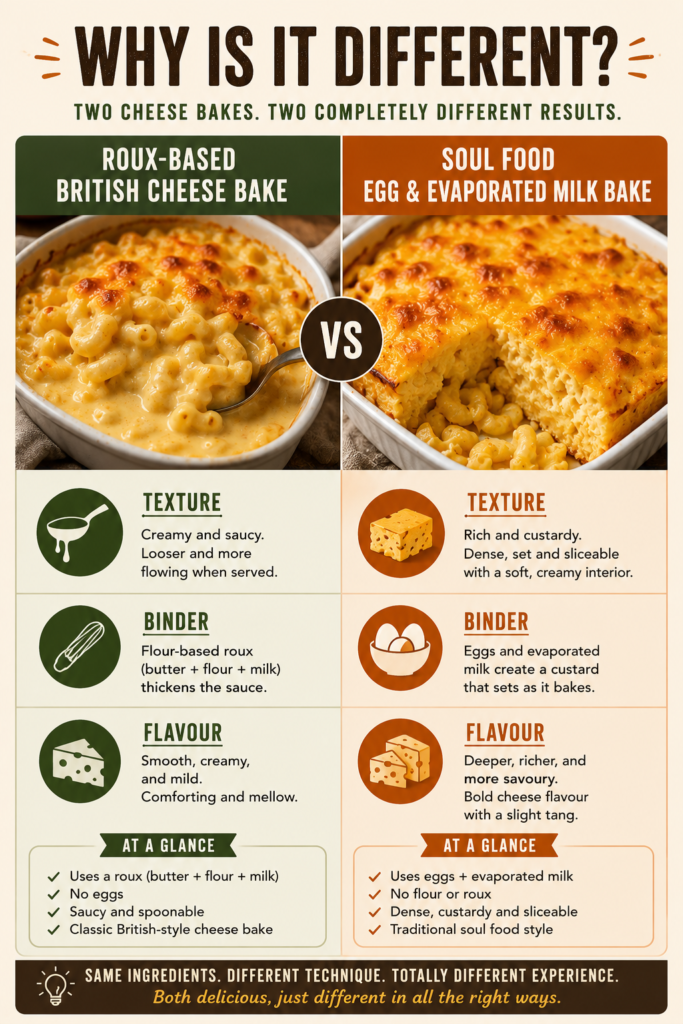
The pasta. Elbow macaroni, cooked just shy of al dente so it holds up through baking without turning mushy. This isn’t the place for fusilli or penne — the classic elbow shape holds the sauce in a way other pasta doesn’t.
The cheese blend. This is where soul food mac and cheese pulls away from a simple cheese sauce. Instead of one cheese, most traditional versions layer two or three: a sharp cheddar for bite, a milder melting cheese like Colby or Monterey Jack for creaminess, and often a block of processed cheese (Velveeta, in the American version) to keep the whole thing silky rather than grainy once it’s baked.
The binder. This is the detail that trips up a lot of home cooks outside the American South. Soul food mac and cheese usually isn’t held together with a flour-based roux the way a British cheese sauce is. Instead, it’s bound with beaten eggs and evaporated milk (sometimes stirred through with a little double cream or half-and-half), which is what gives a proper soul food mac and cheese its dense, custardy texture rather than the looser, saucier texture you get from a roux-based bake.
The seasoning. Salt, black pepper, garlic powder, onion powder, a touch of ground mustard, and a scattering of paprika on top before it goes in the oven. Nothing overpowering — the seasoning is there to round out the cheese, not compete with it.
The bake. Everything goes into a buttered dish and bakes uncovered at around 350°F (roughly 175°C for a UK oven) for about 35-40 minutes, until the top is golden, slightly crisped at the edges, and the middle is set but still soft.
That’s the shape of it. Once you understand why each part is doing what it’s doing, you can start adjusting it with confidence rather than guessing.
Cheese Alternatives and Substitutions (Especially for UK Cooks)
The single biggest hurdle for anyone in Britain trying to recreate soul food mac and cheese is the cheese itself. American recipes lean heavily on Velveeta and sharp American cheddar, neither of which sit on UK supermarket shelves in quite the same form. Here’s how to bridge that gap without losing what makes the dish work.
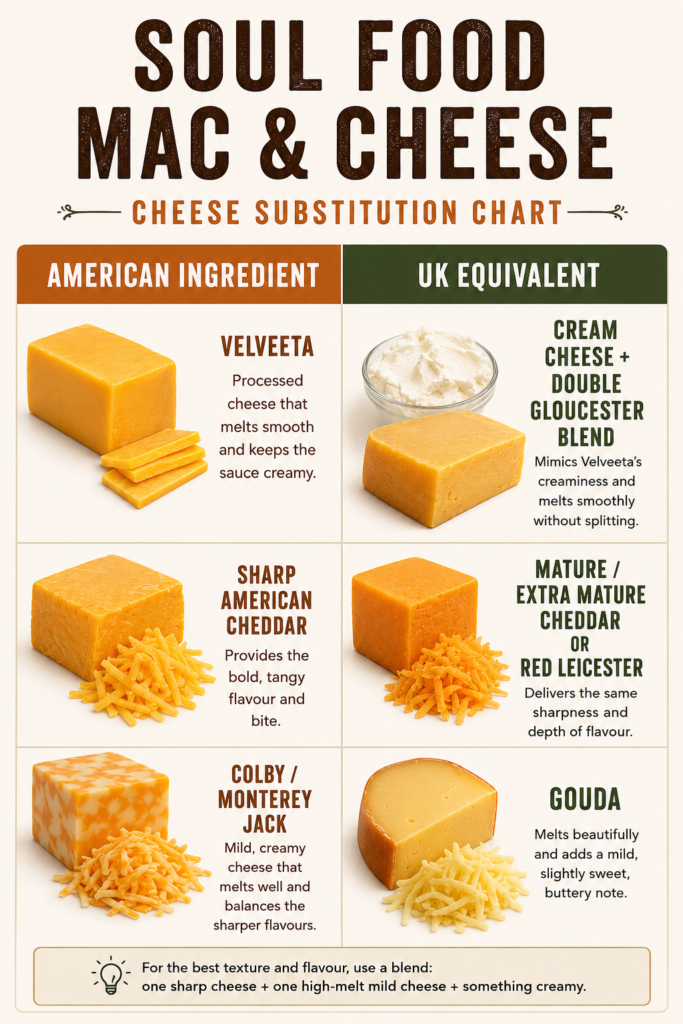
Instead of sharp American cheddar: reach for a mature or extra mature British cheddar. Red Leicester is also a strong stand-in — it has a similar bite to sharp cheddar with a bit more colour, which actually makes the finished bake look even more appetising.
Instead of Velveeta: this is the trickiest swap, because Velveeta’s job is to melt into something ultra-smooth without splitting. A mix of cream cheese and a mild, high-moisture cheese like Double Gloucester gets you close. Double Gloucester has a mellow, creamy quality similar to mild cheddar that blends smoothly rather than turning oily.
Instead of Colby or Monterey Jack: Gouda is a genuinely good option here. It melts beautifully and brings a slightly sweet, buttery note that plays well against a sharper cheddar.
For extra depth: a small amount of Gruyère added to the blend brings a nutty, savoury note that a lot of traditional recipes achieve with aged American cheeses that simply aren’t available here. Use it sparingly — it’s strong.
The rule of thumb: you want at least one sharp cheese for flavour, one high-melt mild cheese for creaminess, and ideally something with a bit of fat and moisture (cream cheese, or a soft cheese like Double Gloucester) to stop the sauce from turning grainy once it’s baked. If you’re still finding your feet with soul food ingredients more broadly, our guide to where to buy soul food ingredients in the UK covers where to find specialist items beyond the supermarket, including the Afro-Caribbean shops that often stock closer equivalents to American cheeses than the big chains do.
Ways to Make It Your Own
Once you’ve got the base technique down, soul food mac and cheese is genuinely forgiving to experiment with:
- Add a breadcrumb topping. Not traditional in most soul food versions, but a scattering of panko or fine breadcrumbs mixed with a little melted butter on top adds a contrasting crunch some people love.
- Stir in smoked bacon or diced ham. A common addition for a heartier, main-course version rather than a side.
- Try a smoked cheese. Swapping a portion of the cheddar for a smoked variety adds a barbecue-adjacent depth that works particularly well if you’re serving it alongside ribs or pulled pork.
- Spice it up. A pinch of cayenne or a few dashes of hot sauce stirred into the cheese sauce is a popular variation for anyone who wants a bit of heat running through it.
- Go lighter on the eggs. If the custardy texture isn’t for you, using one egg instead of two or three, and leaning more on a roux-style base, will give you something closer to a British-style cheese bake while keeping the cheese blend and seasoning true to soul food flavour.
Cooking and Storing Tips
Don’t overcook the pasta before baking. Because it bakes again in the oven, macaroni cooked to full tenderness on the stove will turn mushy by the time it comes out. Aim for just under al dente.
Let it rest before serving. Straight out of the oven, a soul food mac and cheese is molten and loose. Give it 10 minutes to rest and it firms up into cleaner, more satisfying slices rather than collapsing into a puddle on the plate.
Storing leftovers: once fully cooled, keep it in an airtight container in the fridge, where it’ll hold well for three to five days.
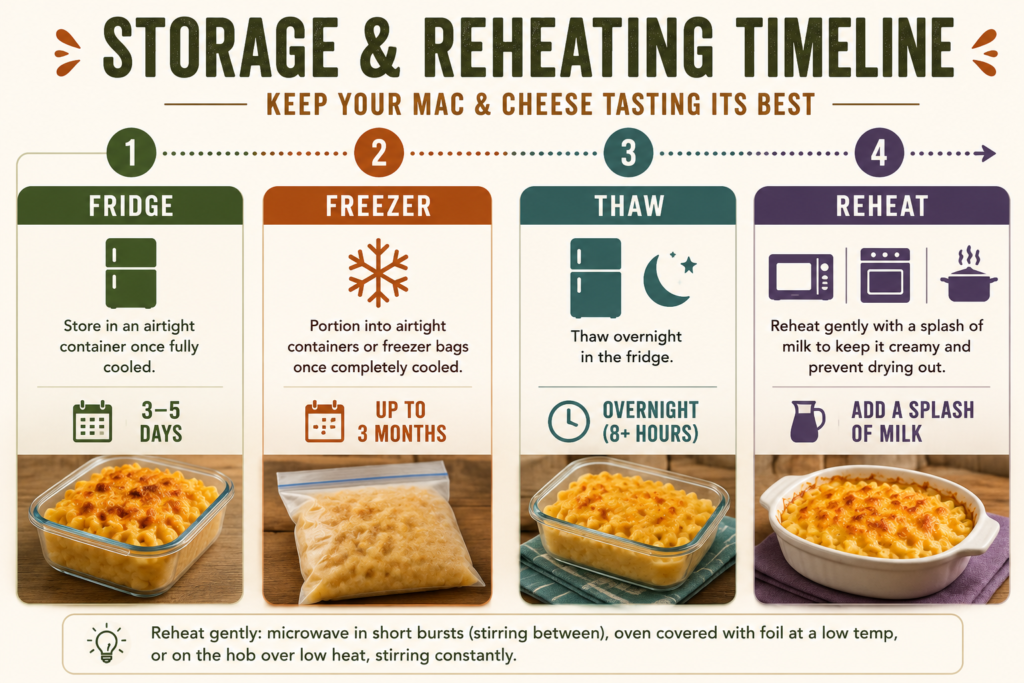
Freezing: soul food mac and cheese freezes reasonably well, though the texture softens slightly on thawing. Portion it into airtight containers or freezer bags once completely cooled, and it’ll keep for up to three months. Thaw it overnight in the fridge rather than at room temperature.
Reheating: the cheese sauce tends to dry out in the microwave if you’re not careful. Stir in a splash of milk before reheating, whether you’re using the microwave (in short bursts, stirring between each one), the oven (covered with foil at a low temperature until warmed through), or the hob (low heat, stirring constantly).
Is Mac and Cheese Really Soul Food?
It’s worth addressing, because it comes up. Mac and cheese sits comfortably in the soul food tradition as one of the essential sides, right alongside collard greens, cornbread, and candied yams, particularly at Sunday dinners and family gatherings. If you want the fuller picture of what qualifies as soul food and why, our piece on whether ribs count as soul food goes into the history and context in more detail. For more of the classic pairings that traditionally sit on the same plate, our roundup of soul food side dishes is a good next stop.
FAQs
Can I make soul food mac and cheese without eggs? Yes. Some cooks skip the eggs entirely and rely on a thicker cheese sauce with extra cream cheese or a small roux instead. You’ll lose some of the classic custardy density, but it still bakes up rich and cheesy.
Why did my baked mac and cheese turn out grainy? This usually happens when the cheese is overheated, or when pre-shredded cheese (which is coated in anti-caking agents) is used instead of cheese grated fresh from a block. Shredding your own cheese and keeping the oven temperature moderate helps avoid it.
What’s the best dish to bake it in? A shallow, wide baking dish gives you more surface area for that golden, slightly crisp top, which most people consider the best part.
Can I make it ahead of time? Yes. Assemble it fully, cover, and refrigerate for up to a day before baking. You may need to add five or so extra minutes to the bake time if it’s going in cold from the fridge.
Note: no recipe schema or recipe card has been added to this post, per the brief.